

By Sunshine Dental of Manchester When you are missing a tooth, the space can affect much more than your smile. It can change the way you chew, speak, and feel about your appearance. It can also allow nearby teeth to shift over time. Two of the most common ways to replace a missing tooth are a dental bridge and a dental implant. If you are comparing dental bridge vs implant options, the right choice depends on your oral health, budget, timeline, and long-term goals. AtSunshine Dental of Manchester, we help patients understand both options clearly so they can make confident decisions. A dental bridge and a dental implant can both restore a missing tooth, but they work in very different ways.
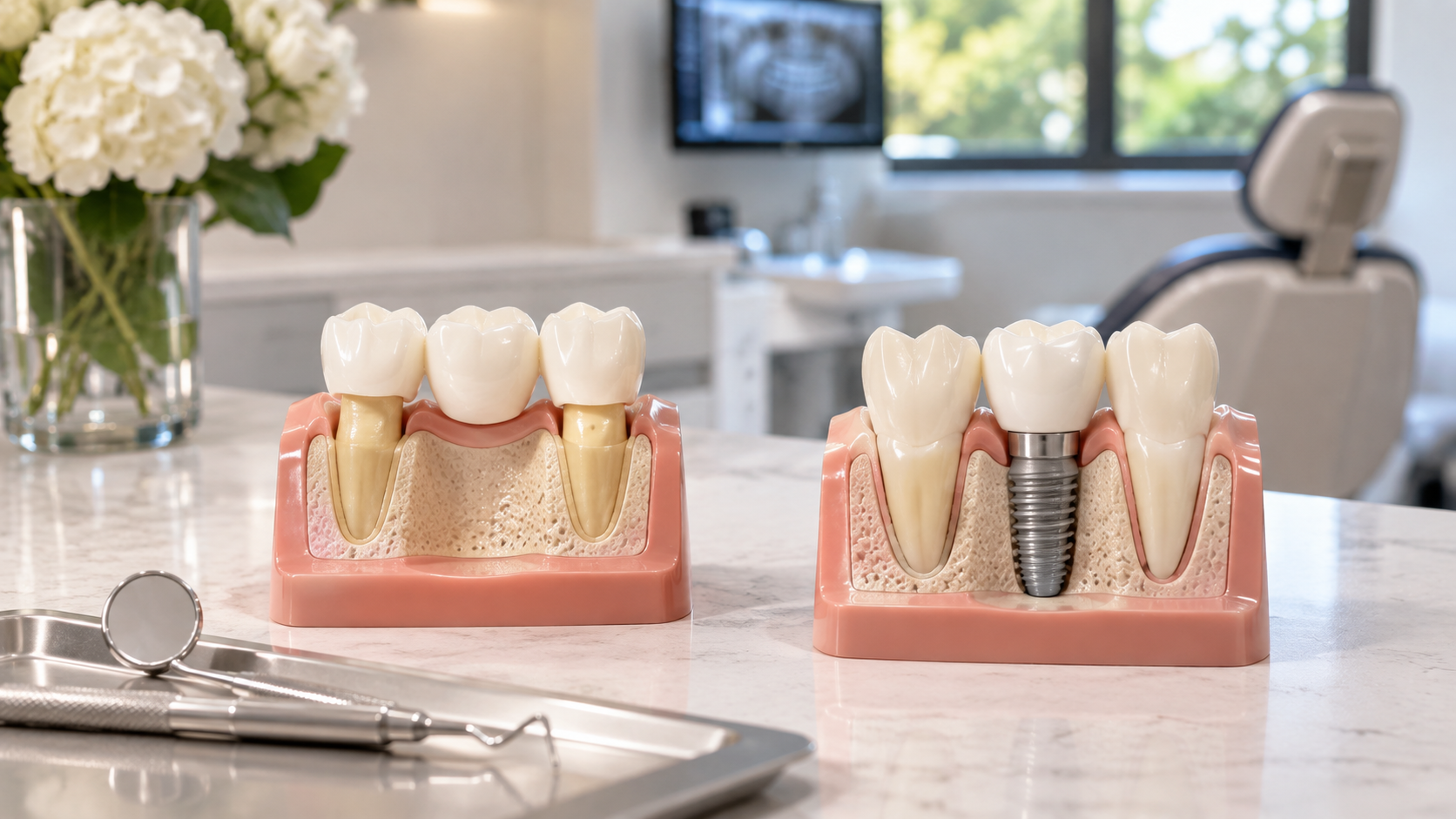
A dental bridge is a fixed restoration that replaces one or more missing teeth by using nearby teeth or dental implants for support. A traditional bridge usually includes crowns on the teeth next to the gap, with an artificial tooth in between. A dental bridge may be recommended when:
A traditional bridge is cemented in place and is not removed at home. You care for it by brushing, cleaning around the supporting teeth, and cleaning underneath the replacement tooth with special flossing tools. For more detail on how bridges are priced and planned, read our related blog: Dental Bridge Cost (in Manchester, CT): What Impacts Price and How to Plan.
A dental implant is a small post that is placed into the jawbone to replace the root of a missing tooth. After the implant heals and bonds with the bone, a crown is attached to the implant to replace the visible tooth. A dental implant may be recommended when:
An implant is different from a bridge because it does not rely on the teeth next to the gap for support. It stands on its own, supported by the jawbone.
The biggest difference in the dental bridge vs implant decision is support. A traditional dental bridge is supported by the teeth next to the missing space. Those teeth are shaped for crowns, and the replacement tooth is attached between them. A dental implant is supported by the jawbone. It replaces the missing tooth root and supports a crown on its own. This difference affects treatment time, cost planning, maintenance, and how the surrounding teeth are treated.
A traditional dental bridge usually involves:
A bridge can often be completed in fewer steps than an implant, especially when no additional treatment is needed.
A dental implant usually involves:
An implant generally takes longer because the jawbone needs time to heal around the implant before the final crown is placed.
Both a dental bridge and a dental implant can look natural when designed well. A bridge replaces the missing tooth and is shaped to match the surrounding teeth. If the missing tooth is visible when you smile, shade matching and gumline design are especially important. An implant crown is also designed to blend with nearby teeth. Because it replaces only the missing tooth and does not connect to neighboring crowns, it can feel very natural in the right case. If you want to understand what changes visually and functionally with bridge treatment, read our related blog: Before and After Dental Bridge: What to Expect from Treatment.
Both options can restore chewing ability, but they do it differently. A dental bridge distributes chewing forces across the supporting teeth. This can work very well when those teeth are strong and healthy enough. A dental implant transfers chewing forces through the implant into the jawbone. This can make it feel similar to a natural tooth, especially once fully healed. Patients who are missing back teeth may need extra attention to bite forces because molars handle significant pressure during chewing.
A dental bridge may be completed more quickly than an implant because it does not require implant healing time. This can make it appealing for patients who want a fixed replacement in a shorter timeframe. A dental implant typically takes longer because the implant must integrate with the bone. If bone grafting is needed, the process can take additional time. In simple terms:
The best choice depends on whether speed, tooth preservation, or long-term independence is more important in your case.
Cost is one of the biggest questions in the dental bridge vs implant conversation. The total investment depends on several factors.
Dental bridge cost can be influenced by:
Dental implant cost can be influenced by:
A bridge may have a lower initial cost in some cases, especially when neighboring teeth already need crowns. An implant may involve a higher initial investment, but it does not require reshaping healthy adjacent teeth. The better value depends on your specific mouth and long-term goals.
This is one of the most important differences.
A traditional bridge requires reshaping the teeth next to the gap so crowns can be placed over them. If those teeth already need crowns, this can make sense. If they are completely healthy, removing enamel may be less ideal.
A dental implant does not require reshaping the neighboring teeth. This can make it a more conservative choice when the adjacent teeth are healthy. At Sunshine Dental of Manchester, we carefully evaluate the teeth around the missing space before recommending one option over the other.
When a tooth is lost, the jawbone in that area no longer receives the same stimulation from chewing. Over time, the bone can shrink. A dental implant helps stimulate the jawbone because it replaces the tooth root. This can help preserve bone in the area. A traditional bridge fills the visible gap, but it does not replace the tooth root. The bone beneath the missing tooth area may still change over time. This does not mean a bridge is a poor choice. It simply means bone preservation is one factor to consider when comparing the two options.
Both bridges and implants require daily care.
A bridge must be cleaned around the supporting teeth and underneath the replacement tooth. You may need:
The supporting teeth are especially important because decay or gum disease around them can affect the entire bridge.
An implant crown is brushed and cleaned like a natural tooth, but the gum tissue around the implant needs careful attention. Plaque buildup around implants can cause inflammation and lead to complications if ignored. Both options require regular dental cleanings and exams.
Both a bridge and an implant can last many years with good care. However, their risks are different. A bridge may need replacement if:
An implant may need attention if:
Good hygiene, bite balance, and regular dental visits are essential for both.
A dental bridge may be the better option when:
A bridge can be a reliable and efficient option when the supporting teeth are appropriate.
A dental implant may be the better option when:
An implant can be an excellent solution for many patients, especially when the missing tooth is surrounded by healthy teeth.
Sometimes the decision is not simple. For example:
This is why a personalized exam matters. The best answer is rarely based on the missing tooth alone. It is based on the entire mouth.
If you are comparing dental bridge vs implant, ask your dentist:
These questions can help you make a decision based on function, health, cost, and long-term care.
There is no one-size-fits-all answer. A dental bridge can be a great choice when nearby teeth need crowns or when a patient wants a fixed option without surgery. A dental implant can be a strong choice when adjacent teeth are healthy and bone support is adequate. The right treatment should protect your oral health, restore comfort, and fit your personal priorities. AtSunshine Dental of Manchester, we take time to explain the advantages and limitations of each option so patients can understand what makes the most sense for their smile. When comparing dental bridge vs implant, the best choice depends on your teeth, gums, bone health, timeline, and long-term goals. A bridge can restore a missing tooth efficiently and may be ideal when nearby teeth already need support. An implant can replace the missing tooth independently and help preserve bone in the area. If you are missing a tooth and want help choosing the right replacement option, we invite you to visit Sunshine Dental of Manchester’s website to learn more or explore our restorative services. You can also read our related articles for more guidance:
Our team atSunshine Dental of Manchester is here to help you compare your options and choose a solution that supports your smile for the long term.
Lorem ipsum dolor sit amet consectetur adipiscing elit ut arcu a dignissim suscipit non ac eget tellus in nisl mauris nec.