

The main types of dental implants are endosteal implants, which sit inside the jawbone, and a small group of specialty designs used when bone is limited. The tooth you actually see on top can be a single crown, a bridge, or a full arch of teeth held by several implants. For patients in Manchester, CT, the right choice comes down to how many teeth are missing, how much bone is left, and whether you want teeth that stay in or snap out.
Our team at Sunshine Dental of Manchester walks patients through these options during every implant consultation. Knowing the vocabulary ahead of time makes it much easier to ask good questions and weigh the trade-offs with confidence.
Every implant has three parts, no matter which of the types of dental implants you choose. Understanding them makes the rest of the options easier to follow.
Titanium works because bone bonds to it over time. This fusion is called osseointegration, which simply means the bone grows snugly around the post until it is locked in place. On our dental implants service page, we explain that this healing stage usually takes about 3 to 4 months before the final crown is attached.
That stable foundation is what lets an implant look, feel, and function much like a natural tooth. It also gives the jawbone the stimulation it would otherwise lose after a tooth is gone.
Where the implant sits is the first way dentists sort them. Most patients only ever need the first category below, but it helps to know the others exist.
Endosteal implants are the most common design used today. "Endosteal" means "within the bone," and that is exactly where the post goes: into the jaw, shaped like a small screw or cylinder.
They need enough healthy bone to hold them securely. When a tooth has been missing for months or years, the bone may have thinned, and a bone graft is often placed first to rebuild the site.
A subperiosteal implant is a custom metal frame that rests on top of the jawbone, under the gum tissue, rather than inside it. Posts on the frame poke through the gums to hold the replacement teeth.
This design is rarely used now. It was developed for people without enough bone for a standard implant, and bone grafting has since made endosteal implants possible for many of those patients.
Zygomatic implants are extra-long posts anchored in the cheekbone instead of the upper jaw. They are reserved for severe bone loss in the upper jaw when grafting is not practical.
This is a complex, specialist procedure. Your dentist can tell you whether your case is one of the rare situations that calls for it.
Mini implants are narrower versions of the standard endosteal post. They are sometimes used in tight spaces or to help stabilize a lower denture.
Because they are thinner, they are not the right fit for every bite. Your dentist weighs your chewing forces and bone before recommending a narrower post.
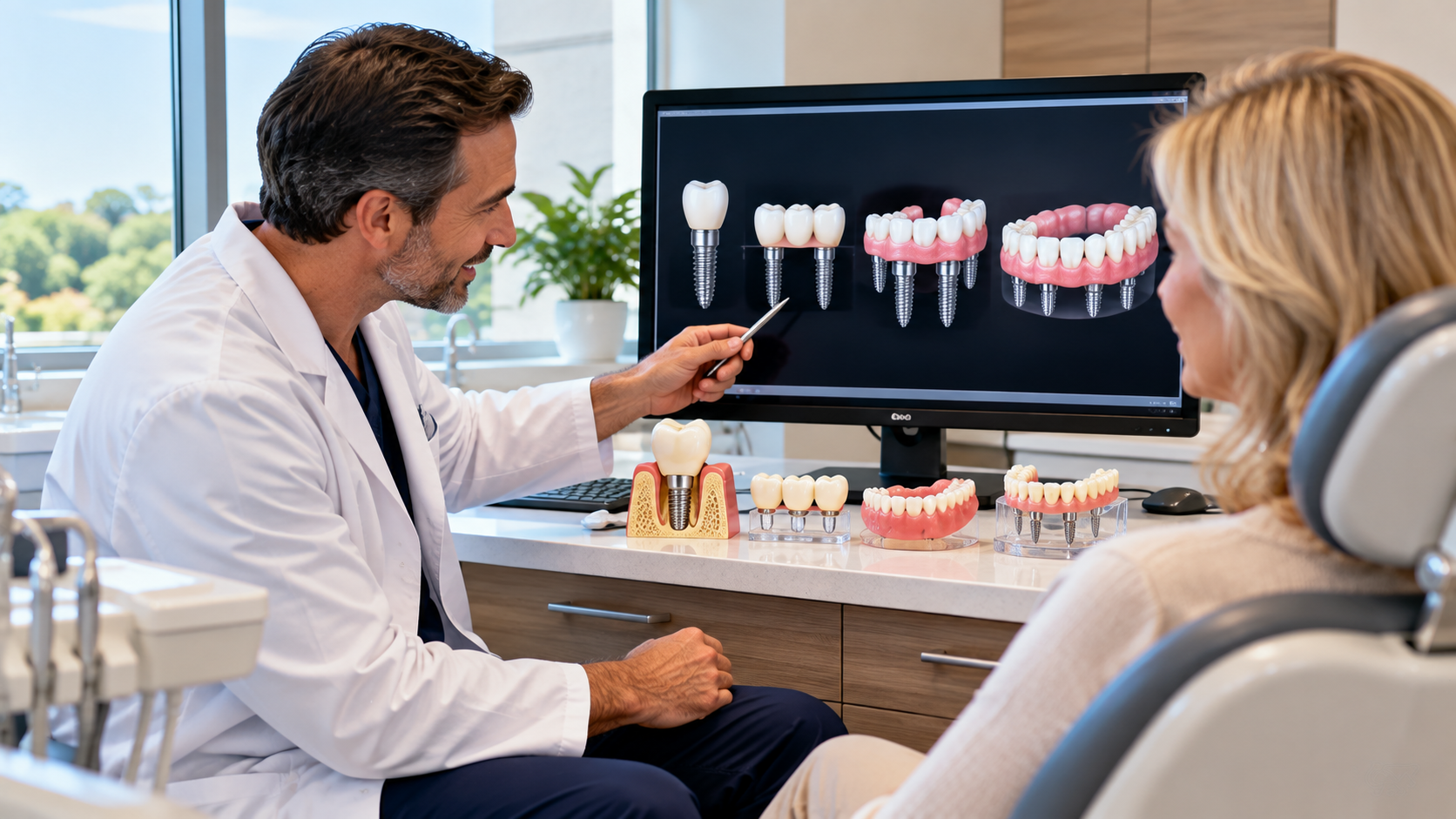
The second way to group implants is by the restoration on top. This is usually the choice patients care about most, because it decides how your new teeth look, feel, and get cleaned.
One implant replaces one missing tooth, topped with a custom crown. It stands on its own, so the teeth on either side do not need to be reshaped.
This is the classic option for a single lost or failing tooth anywhere in the mouth.
When several teeth in a row are missing, two or more implants can anchor a bridge that spans the gap. Fewer posts support more teeth, which can reduce surgery and cost compared with one implant per tooth.
If you are deciding between a traditional bridge and an implant, our guide to dental bridge vs implant compares the two side by side.
Implants can also hold a full denture in place. With as few as 2 implants in the lower jaw, a denture can snap onto the posts, making it far more stable while chewing than a denture that relies on suction alone.
Placing 4 to 6 implants connected by a custom support bar gives an even firmer fit called an overdenture. It still comes out for easy cleaning. You can read more about these options on our implant retained dentures page.
For patients who want teeth that never come out at home, a full arch can be secured to several implants with screws or clasps. It is removed only at maintenance visits.
Cleaning under a fixed arch takes more time and dexterity. Many patients still prefer it because it feels the closest to having natural teeth again.
| Option | Implants usually involved | Removable at home? | Often a good fit for |
|---|---|---|---|
| Single implant crown | 1 | No | One missing tooth |
| Implant-supported bridge | 2 or more | No | Several missing teeth in a row |
| Snap-in lower denture | 2 | Yes | Loose lower dentures |
| Bar-retained overdenture | 4 to 6 | Yes | A firmer denture that still comes out for cleaning |
| Fixed full arch | 5 or more | No | A full set of teeth that stays in |
Common implant restoration options discussed with patients at Sunshine Dental of Manchester in Manchester, CT.
Sunshine Dental of Manchester · Manchester, CT
Not sure which implant option fits your smile? Book a visit and our team will review your imaging with you and explain every choice that suits your case.
Book an appointmentThe types of dental implants also differ in how quickly you get your new teeth. Both paths use the same kind of post; what changes is the schedule.
A staged plan starts with a consultation, imaging, and a review of your medical and dental history. If needed, the tooth is removed, and a bone graft is placed when the site needs more support.
After several months of healing, the implant post is placed. Once it has fused with the bone, usually 3 to 4 months later, the abutment and final crown are attached.
Some patients can have a tooth removed, an implant placed, and a temporary tooth attached in a single visit. That temporary tooth is for looks and light use while the bone heals.
The final crown or arch still comes after healing. Our article on same day dental implants in Manchester, CT covers who qualifies and what recovery looks like.
There is no single best implant for everyone, and the types of dental implants we recommend depend on your mouth. At your consultation, our team looks at a few key factors before recommending a plan.
Implants need solid bone to hold them. The upper jaw has softer bone than the lower jaw, so upper cases often need more implants to support the same number of teeth.
If bone has thinned after a tooth loss, bone grafting and socket preservation can rebuild the area so a standard implant can be placed later.
One missing front tooth and a full lower arch call for very different solutions. The location also affects the bite forces the implant must handle, since back teeth take far more pressure during chewing.
Healthy gums free of active infection give an implant the best start. Well-controlled conditions such as diabetes, and not smoking, also support healing, so we review your full health history before treatment.
Cost varies widely by type, from one crown to a full arch. Many dental plans cover part of implant treatment, but coverage depends on your policy.
Medicare questions come up often, and our practice does not accept Medicare. Our guide to financing for dental implants and whether Medicare covers them explains the details and other ways to plan for the cost.
A good consultation is a two-way conversation. Bringing a short list of questions helps you leave with a clear picture of your options.
There are no wrong questions here. Our team would much rather talk through a concern at the start than have you feel unsure halfway through treatment.
It also helps to bring a list of your current medications and any recent dental records or X-rays from another office. That gives us a fuller picture of your health from the first visit and can save time during planning.
With good care, the implant post itself can often last a lifetime, according to the Cleveland Clinic’s overview of dental implants. The parts on top wear with daily use and may eventually need replacing.
The same source notes that crowns and bridges on implants tend to last around 15 years, while implant-supported dentures last at least 7 years. Daily brushing, flossing around the abutments, and regular professional cleanings help every type of implant last as long as possible.
Whichever of the types of dental implants you choose, keep your routine checkups. They let us catch small issues such as a worn denture clip or gum irritation long before they become bigger problems.
Endosteal implants are the most common type. A small titanium post is placed directly into the jawbone, where it fuses with the bone over about 3 to 4 months. It can then support a single crown, a bridge, or a denture, which is why it suits most patients who have enough healthy bone.
The best implant depends on your situation. A single implant crown is ideal for one missing tooth, while a bridge or full arch suits several missing teeth. Your bone volume, gum health, goals, and budget all matter, so a consultation with imaging is the most reliable way to find your best fit.
Often, yes. A bone graft can rebuild thin areas of the jaw so a standard implant can be placed after healing. Placing more implants or choosing an implant-retained denture can also help. In rare cases of severe upper jaw bone loss, specialty implants anchored in the cheekbone may be considered.
A traditional implant usually takes several months from start to finish. After the post is placed, the bone needs about 3 to 4 months to fuse with it before the final crown goes on. A bone graft adds healing time, while some patients qualify for a temporary tooth on the same day as surgery.
Whichever implant type you are curious about, the first step is a conversation and a careful look at your imaging. Our team at Sunshine Dental of Manchester, on Spencer Street in Manchester, CT, is happy to answer your questions and build a plan around your goals. Contact our Manchester office or call (860) 432-8881 to schedule your implant consultation.
Lorem ipsum dolor sit amet consectetur adipiscing elit ut arcu a dignissim suscipit non ac eget tellus in nisl mauris nec.